本页尚未翻译,你正在阅读英文版。
Rates and RevBot
Set base rates, weekday rates, seasons, rate plans and stay limits, and use RevBot's price suggestions or autopilot.
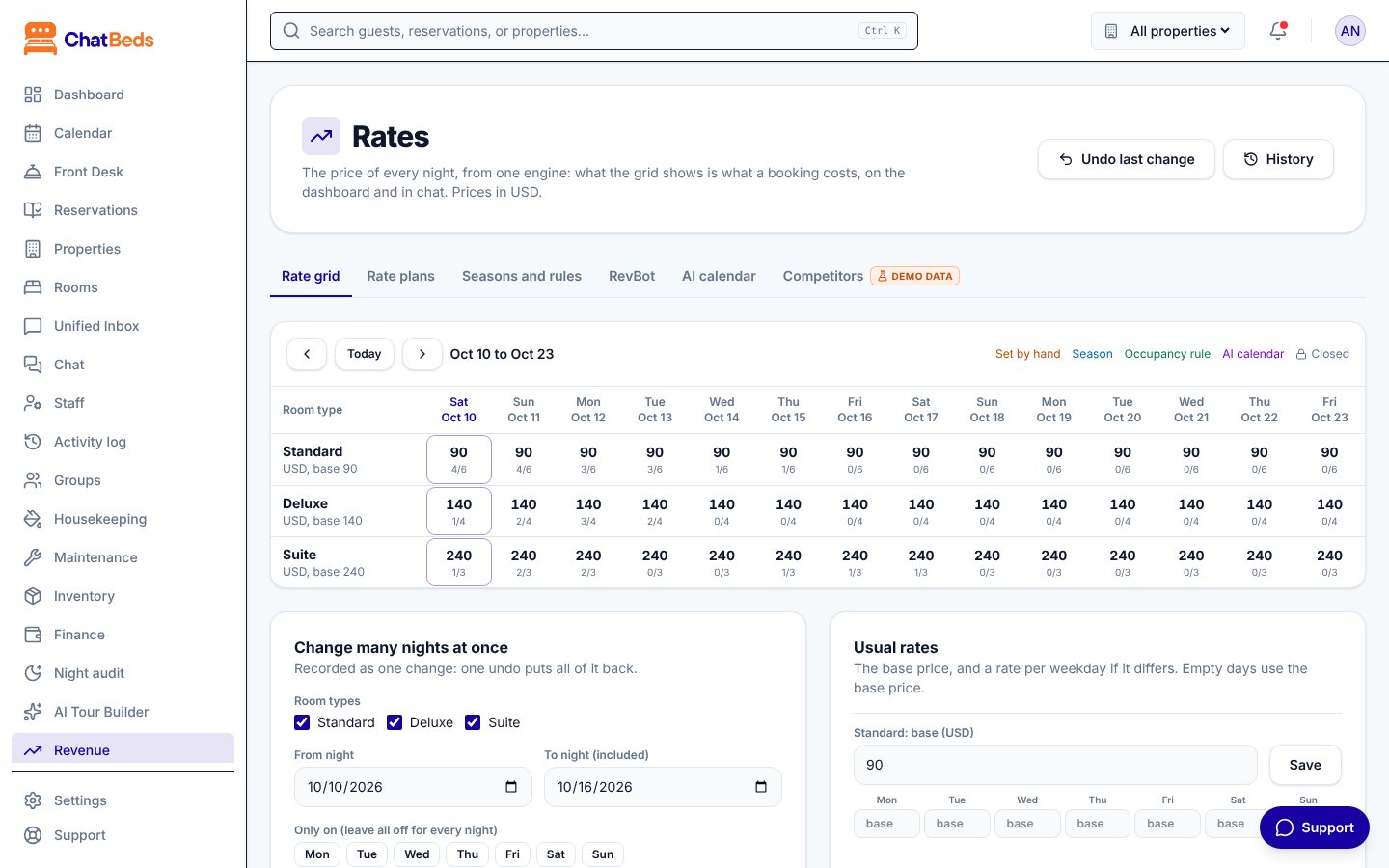
One pricing engine sets the price of every night. What you see on the rate grid is exactly what a booking costs, on the dashboard, on your booking page and in WhatsApp.
You manage rates on the dashboard under Sales and revenue → Rates. The page has these tabs: Rate grid, Rate plans, Seasons and rules, RevBot, Price calendar and Competitors.
Who can change rates
Everyone signed in can see rates. Only an owner or admin can change them on the dashboard. In WhatsApp, the owner and GM can change rates, and the front desk manager can look at them.
How a night is priced
For each room type and night, ChatBeds uses the first of these that exists:
- Set by hand: a price you typed on the grid or in WhatsApp (or a RevBot suggestion you applied).
- Price calendar: a price from the price calendar, with its reasons.
- Season: a fixed price, or the usual rate moved by a percentage, between two dates.
- Weekday rate: the room type's price for that day of the week.
- Base price: the room type's standard price.
The grid colours each night by where its price came from.
Base price and weekday rates
On the Rate grid tab, open Usual rates. Set the base price, and a rate per weekday if it differs (for example, higher on Fridays and Saturdays). Empty days use the base price.
Seasons
On Seasons and rules, click Add under Seasons. Give the season a name, the First night and Last night, the room types, and the rate. The rate can be a fixed price or The usual rate moved by %. You can also set a Minimum stay for arrivals in the season.
Where two seasons overlap, the shorter season wins.
Occupancy rules
Occupancy rules move the rate when a room type gets full. For example: "When sold (%) or more" 80, "Move the rate by (%)" 10.
- Only the highest threshold reached applies.
- You can limit a rule to nights within a number of days.
- A price set by hand (or by the price calendar) is never moved by a rule.
Rate plans
On Rate plans, click Add a rate plan. A plan is worked out from the room type's rate, or from another plan, and changes it by a percent or an amount. For example, "Non-refundable, 10% cheaper".
A plan can also have:
- Meals: Room only, Bed and breakfast, Half board, Full board or All inclusive.
- Minimum nights and Maximum nights.
- Non-refundable, or its own Cancellation policy.
- One room type only, or every room type.
- Default plan, and On sale or off sale.
A plan that has been used by a booking can't be deleted. Take it off sale instead.
A cancellation policy for one room type
A room type can have its own cancellation policy, without making a rate plan for it. For example, the Family Suite needs 7 days' notice while every other room can be cancelled for free until the day before. On Rooms, edit the room type and choose its Cancellation policy (make policies in Settings → Cancellation policies). Hotel's usual policy means it has none of its own.
Which policy a booking gets, most specific first:
- Its rate plan's own policy (or a non-refundable plan).
- Its room type's policy.
- On the booking page: the policy for online bookings. Elsewhere: your default policy.
The booking page shows each room's own terms, and a booking keeps the policy it was made under.
Change one night or many
- One night: click a night on the grid. Set the price, close it, set a minimum or maximum stay, close it to arrival or departure, or close one rate plan only.
- Many nights: use Change many nights at once. Pick the room types, From night and To night (included), and optionally only some weekdays. Then choose what to do: set the price, move it by % or an amount, go back to the usual rate, close, open, or set a minimum or maximum stay. Up to 365 days at once.
Closing dates and stay limits
- Closed means no new bookings for that night. You can close a whole room type or one rate plan.
- Minimum and maximum stay are checked on the arrival night.
- Closed to arrival (CTA) means no stay may start that night; guests already in, or arriving earlier, can stay through it. Closed to departure (CTD) means no stay may end that morning. The grid shows them as CTA and CTD.
- These rules apply to new bookings only. Your team can still extend a guest's stay over a closed night.
Undo a change
Every change to the grid, base prices and weekday rates is recorded. Click Undo last change, or open History and click Undo on a change. The old prices come back exactly.
You can't undo a change if a newer change touched the same nights. Undo the newer one first.
Not in the history
Making or editing rate plans, seasons and occupancy rules is not recorded. To undo those, change them back on their tabs.
Rates in WhatsApp
| Send | What it does |
|---|---|
rates | The next 7 nights' rates (or rates deluxe next week) |
rate 220 | Set tonight's rate (rate deluxe 250 this weekend) |
increase suites by 15% | Raise rates (tonight unless you say when) |
drop standard rooms to 140 this weekend | Lower rates |
flash sale 20% | A percentage off tonight, every room type |
close deluxe tonight | Stop new bookings (open deluxe tonight to undo) |
min stay 3 this weekend | Minimum nights for stays arriving then |
rate history | The last rate changes and who made them |
revert rate | Undo the last rate change |
revert rate to undo.RevBot
RevBot looks at each room type for the next 14 nights. It checks how many rooms are sold and how many were booked in the last 7 days (the pace). Then it suggests a change:
| The night | Suggestion |
|---|---|
| 90% sold or more | +15% |
| 75% sold or more | +10% |
| 50% sold or more, and many rooms booked in the last 7 days | +10% |
| Tonight or tomorrow, under 20% sold | −15% |
| Within 3 days, under 30% sold | −10% |
RevBot leaves alone closed nights and nights where a person set the price by hand. It looks again after every booking, cancellation and no-show. New suggestions go to the owner and GM on WhatsApp.
Limits
RevBot always stays inside your limits:
- Floor and Ceiling: it never suggests below or above these. You can set them for the whole hotel or per room type.
- Largest single change (%): the most it moves a rate at once (20% unless you change it). It also never drifts further than this from the night's usual rate, however many times you apply.
Apply, dismiss or undo
Open Rates → RevBot. Click Look now to check again. For each suggestion, click Apply or Dismiss, or use Apply all or Dismiss all. To undo, use Undo last change or History.
A dismissed night is not raised again for 24 hours. A suggestion whose night changed price since it was made is refused as out of date.
Autopilot
With autopilot on, RevBot applies its own suggestions within your limits and tells the owner and GM what it changed. You can switch it on only when every room type on sale has a floor and a ceiling.
- Dashboard: Rates → RevBot → Limits and autopilot. Tick Autopilot: let RevBot set rates within these limits.
- WhatsApp:
autopilotshows your limits. Sendautopilot onorautopilot off,floor 90,ceiling 400,floor deluxe 90ormax change 15%.
floor 90, ceiling 400, max change 15%, autopilot on or autopilot off.The price calendar
On Rates → Price calendar, ChatBeds works out a price for each room type and night for the next 90 nights. It starts from your usual rate (season, weekday rate or base price) and adds:
| What | How much | The reason shown |
|---|---|---|
| Busy nights | From your own last 26 weeks: nights that usually fill more than average go up (up to 15%), quiet ones down (up to 10%). Without enough history yet, the nights before your country's weekend get +10% | "Saturdays are usually 82% full here (average 60%) (+10%)" or "Weekend night (+10%)" |
| Public holidays | Your country's holidays and the night before, by the percent you choose (15% to start) | "Public holiday: Eid-ul-Fitr (estimated) (+15%)" |
| Events | Your own events, each with its percent | "Event: Lahore Literary Festival (+20%)" |
| Rooms already sold | +15% at 90% sold, +10% at 75%, +10% when half sold 3 weeks ahead, +5% when many were booked in the last 7 days, -10% when few are sold a week before | "3 of 4 rooms already sold (75%) (+10%)" |
| Competitors | When you're more than 10% below their median price for the night, half the way up (up to 15%); more than 15% above with under half your rooms sold, half the way down (up to 10%) | "Competitors ask PKR 15,000 (3 competitors, the median) (+15%)" |
The percents add up. Then RevBot's limits apply: never more than your largest single change from the usual rate, never below your floor or above your ceiling (set under RevBot → Limits and autopilot). When a limit holds a price back, the reason says so.
- The tab shows the calendar first, night by night, with the usual rate, the price and why. Nothing changes until you click Set the calendar (90 nights).
- Setting it is one change in the History: Undo puts every night back.
- A price set by hand always wins over the calendar. A night with nothing to add keeps your usual rate.
- With the autopilot on, the calendar is set again every morning, after competitors' prices are read. RevBot's own suggestions for the next days then move on from it, within the same limits.
Under What it takes into account, switch public holidays (and their percent) or competitors' prices on or off.
Events
Under Events, add a festival, a fair, a match or a conference: its name, dates and how much it moves prices (for example +20%, or -10% for a quiet one). You can also paste the address of a calendar of local events (an .ics or webcal:// link, from Google Calendar for example) and click Save and read: its events are added at +20% and read again every day.
Why is Saturday 14,000?
- On WhatsApp, send
why sat,why 17 Octorwhy is Saturday 14000: each room type's price that night and where it comes from (set by hand, the price calendar and its reasons, a season, the weekday rate or the base price). - To Ana, ask "why is Saturday 14,000?".
- On the rate grid, hold the pointer on a night.
Competitors
On Rates → Competitors, add up to 10 hotels you compare yourself with.
Your price service (you pay it, not ChatBeds)
Competitors' prices fill in by themselves when you connect a rate-shopping service of your own:
- Under Your price service, click Connect and choose the service:
- Makcorps: prices from Booking.com, Expedia, Agoda, Hotels.com and more. Sign up on makcorps.com (monthly plans, paid by you to Makcorps), then paste your API key.
- Xotelo (free): the lowest price TripAdvisor shows. No key; each competitor needs its TripAdvisor link.
- ChatBeds tries the key, then keeps it encrypted. It is never shown again; paste a new one to change it.
If the key stops working (wrong, expired, out of credits), reading stops, the page says why, and your managers get a WhatsApp message. Prices read before are kept. Disconnect stops it; the prices stay.
Each competitor's links
Under a competitor, click Add a link and paste its page on Booking.com, Airbnb, Expedia, Hotels.com, Agoda or TripAdvisor: the full address from the browser (short "share" links are refused: open them first). One link per site.
- Each link opens that site on tonight's dates (check prices), for a quick look yourself.
- With your price service, ChatBeds finds the competitor in it by name and your city. One clear match is taken; if several could be it, you pick. Find it in your price service searches by another name.
ChatBeds never reads the booking sites themselves: their terms forbid it, and the prices come from your service.
When prices are read
- The next 30 nights every day, later nights (up to 90) each Monday: fewer reads, so your plan's credits last. Read now reads the next 30 at once.
- The lowest price across the sites, for one room, two adults, one night, in your currency. The site it was found on shows when you hover over a price.
- A competitor whose price falls by 20% or more for a night in the next 30 is flagged under its name, and your managers get a WhatsApp message.
Typed in
Without a service, or for a competitor not matched, type its prices in.
Either way, the price calendar compares your price with their median each night. On WhatsApp, compset shows the next nights.
For occupancy, ADR and RevPAR figures, see Reports and figures.
还需要帮助?
Channels (Airbnb, Booking.com and more)
Link each room's calendar with Airbnb, Booking.com, Vrbo, Expedia or Google Calendar so a room sold in one place shows as taken everywhere.
Promo codes, corporate rates and gift vouchers
Promo codes that lower the room price on your booking page and for partners, private corporate rates offered only with their code, and gift vouchers guests spend on their bill.